By Gillian Gustar
The Village of Martin and W.H. Hudson
In Part 1 of this series, I cited Ford’s comments on visiting Maurice Hewlett, the English historical novelist who he “liked very much” despite feeling some rivalry with him.1 Almost in passing Ford added that his visits were “when Hudson had his hiding hole in the valley behind.” This loosely dates the visits because Hudson was living in Martin, a village about four and a half miles from Broad Chalke, by 1901,2 and Ford wrote to him there in 1904.3 Violet Hunt recalls their visit to Fordingbridge in 1910 and attempts to track down “the mysterious Mr. Hudson” who, although they did not see him later told her that he had been living in the village “on the day we drove through”.4
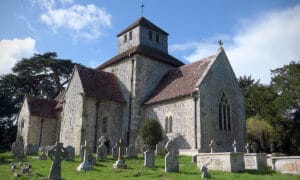
By car the journey between Broad Chalke and Martin takes only about ten minutes but we had reason, beyond good weather, to walk it. We followed a ridge path up to Knighton Hill to assure ourselves that Andrew’s assertion that Ford’s Mr. Sorrell could have seen the distant spire of Salisbury Cathedral from it held good.5 Thankfully, it did and we could move on with clear consciences down through hazel woods, briefly crossing the A354 before tracing paths through fields to the village of Martin. More precisely, we arrived at its Church, All Saints, where we stopped to eat a picnic lunch on a bench in the grounds briefly exchanging pleasantries with the first two people we had encountered since leaving Broad Chalke. It is very easy to feel that you have escaped from the modern world in those Wiltshire landscapes.
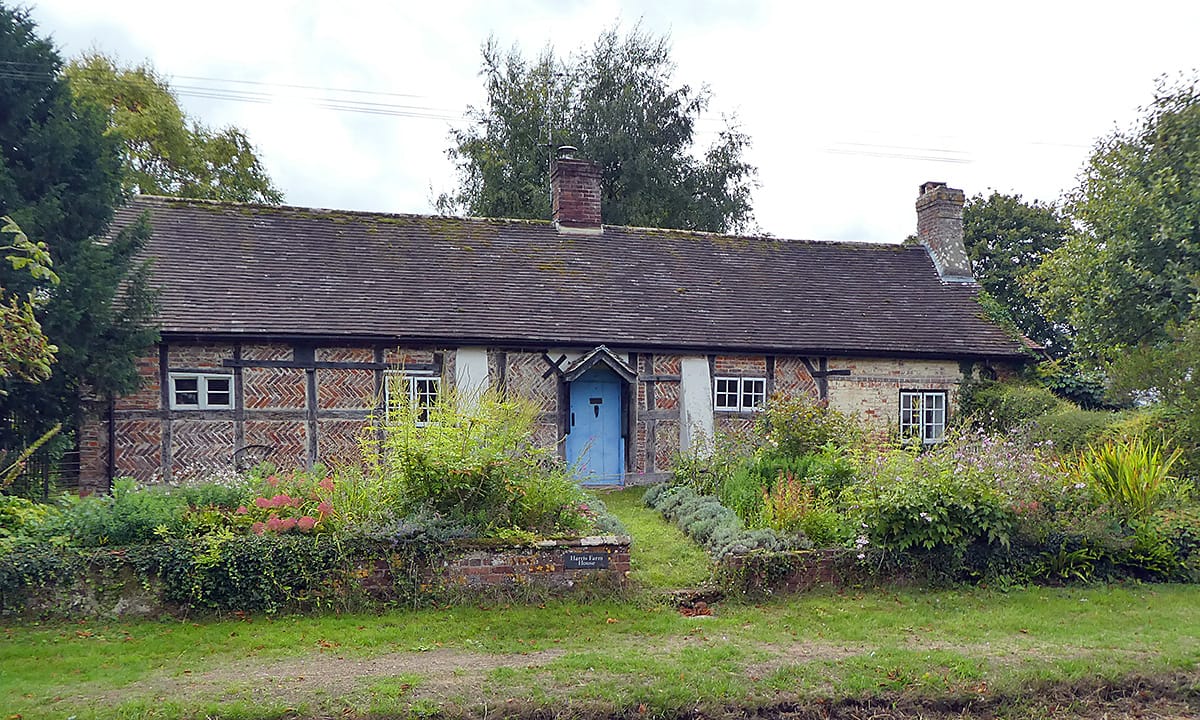
The Church is just off the road which runs through Martin, a village proud of its “many picturesque old cottages and farmhouses” some of which date “back to the 15th century”.6 One of these, of course, was Hudson’s “hiding hole”: Harris Farm, pictured.
It is one of the oldest buildings in the village, dating back to the late sixteenth century, and Hudson features as a selling point in estate agent details, though it is hard to imagine that Harris Farm when he lived in it would have been as expensive or extensive.
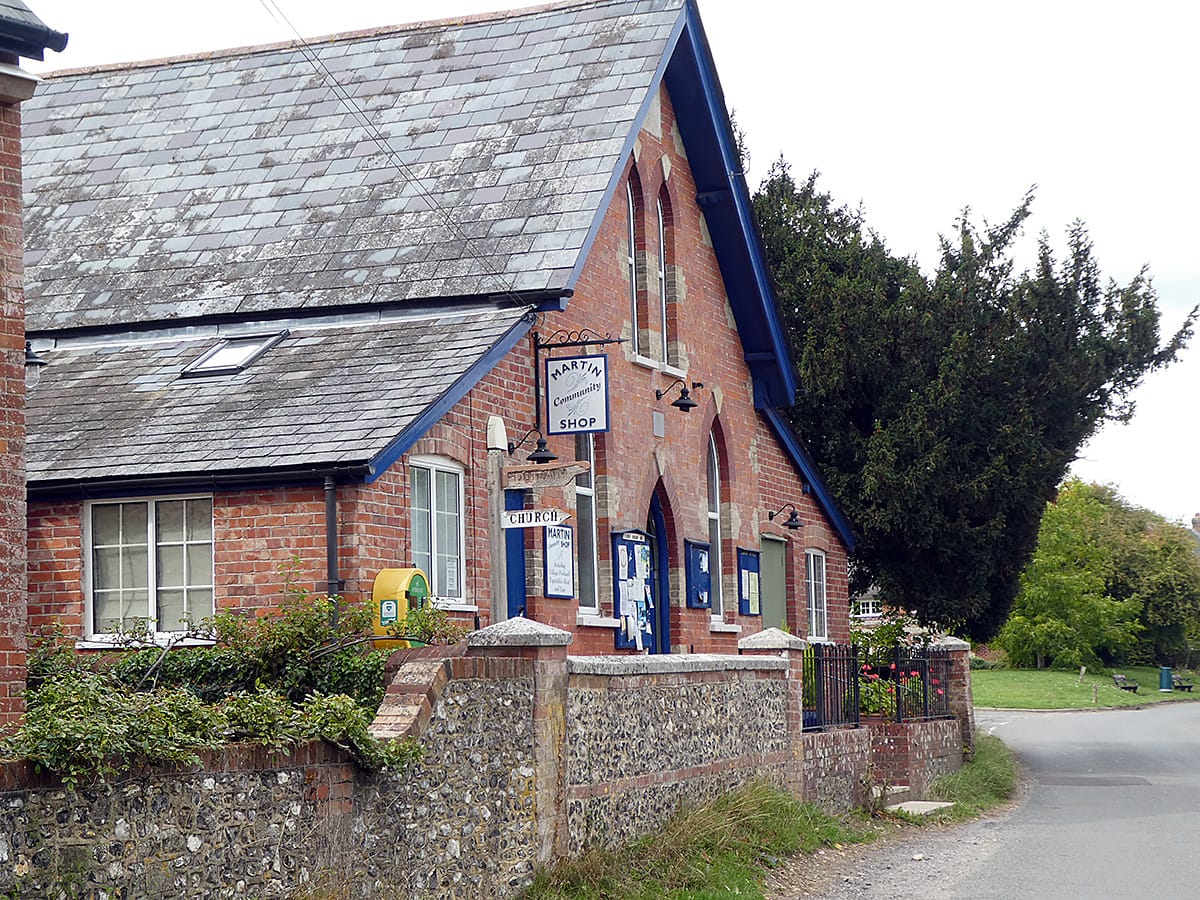
As we had entered the road virtually opposite the Village Hall and Community shop, housed in what had originally been a Baptist Church, we turned towards it to take a photograph. In doing so, we might have missed Harris Farm, now behind us, if not for a chance conversation with a local resident who directed us to it.
He proved to be remarkably well informed about Hudson. Indeed, a key piece of learning from this trip was that being willing to pause long enough to chat about what you are doing beyond rambling through lovely scenery can pay dividends. Having learned that we were researchers, our guide not only pointed us to useful online archives, but suggested that we might like to see the memorial to one of the people on whom Hudson based his A Shepherd’s Life (1910), a Celtic Cross in the graveyard of the village church. Obviously, we detoured back to the graveyard which we had treated as a mere picnic spot and found the cross and a memorial for William Lawes, who ‘died December 14 1886, aged 86’ and his wife Mary who died three months later.7
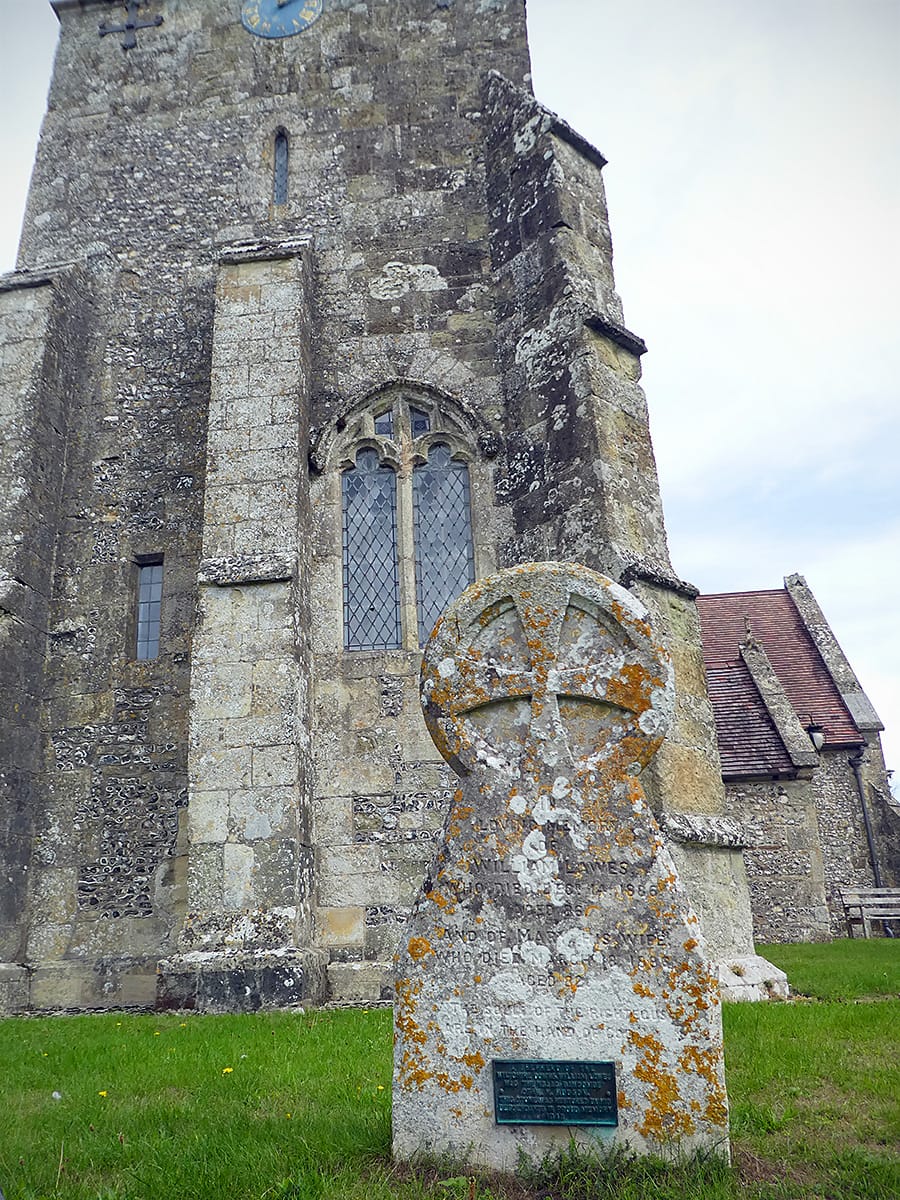
The photograph shows the suitably weathered cross in front of the Church. The bronze plaque at the base reads as follows…
A SHEPHERD OF THE
WILTSHIRE DOWNS, WILLIAM LAWES
WAS THE “ISAAC BAWCOMBE”
OF W. H. HUDSON.
THIS STONE WAS RESTORED BY HIS
DESCENDANTS IN PROUD MEMORY.
1949
William Lawes and his son James, the models for Isaac and Caleb Bawcombe in the book, were people Hudson got to know over many years and Jameson suggests that the pseudonyms might have been a “condition of their contract”.8 An article in the Martin village archives, which gives the background to the memorial stone, suggests that such restrictions might indeed have been applied because a descendent recalls that James Lawes wife had been uncomfortable with Hudson’s note taking.
Though Hudson’s A Shepherd’s Life was published later than Ford’s Heart of the Country trilogy (1905-7) it was clearly an active project in the period when the two men were in regular contact. It would be perverse to imagine that they had not discussed their attempts to capture aspects of rural life. I like to visualise them leaning on that Celtic Cross in the early evening sun, dusty and physically tired from a long walk but mentally energised by their conversations. After all, Ford said of Hudson that he “appeared to be full of the queerest knowledges,” and his range of them was so “extraordinary and disconcerting” that it made him “a person very dangerous to argue with”.9 It is a mental stretch to believe that Ford would not have braved that danger!
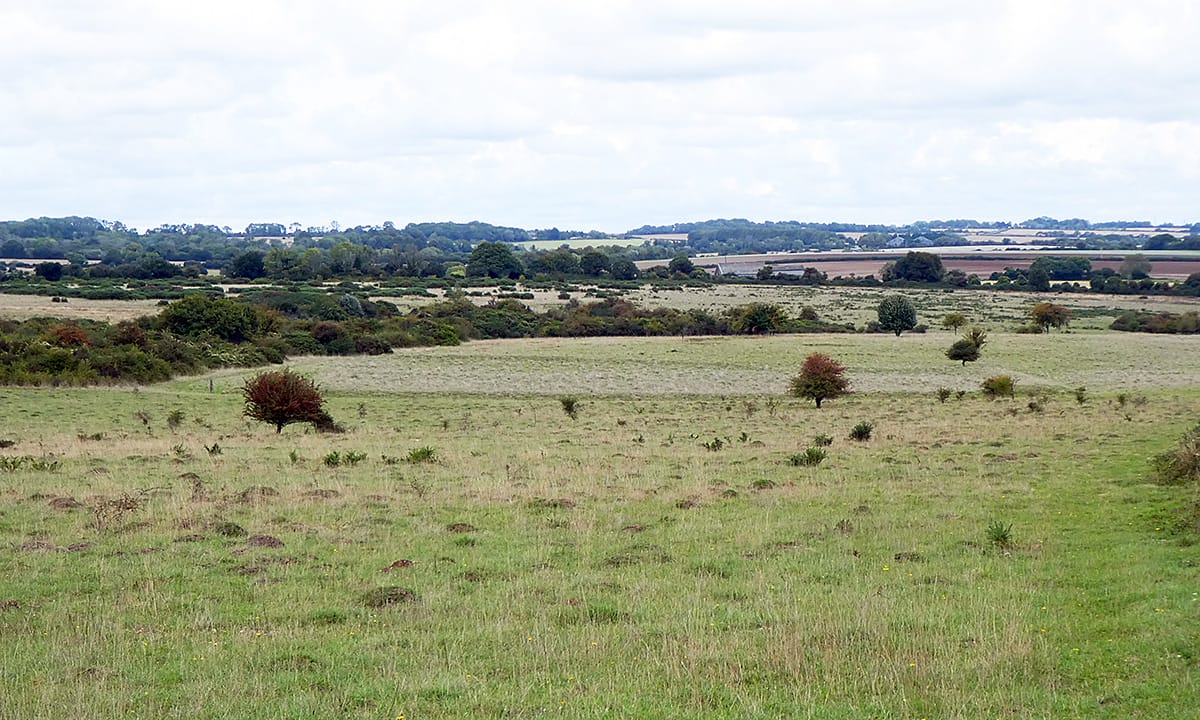
One of the peculiar things about visiting places in which Ford spent time is that he can feel very present. Our return walk to Broad Chalke had been planned to take in Martin Down Camp, not far outside the village, to test Andrew’s argument that the castle given to Sorrell in Ladies Whose Bright Eyes was a Fordian invention based on this real-life location.10
The location and views from it were as expected, so confirmed the map analysis, though as the photograph illustrates, signs of the bronze age camp were not easy to make out from ground level.
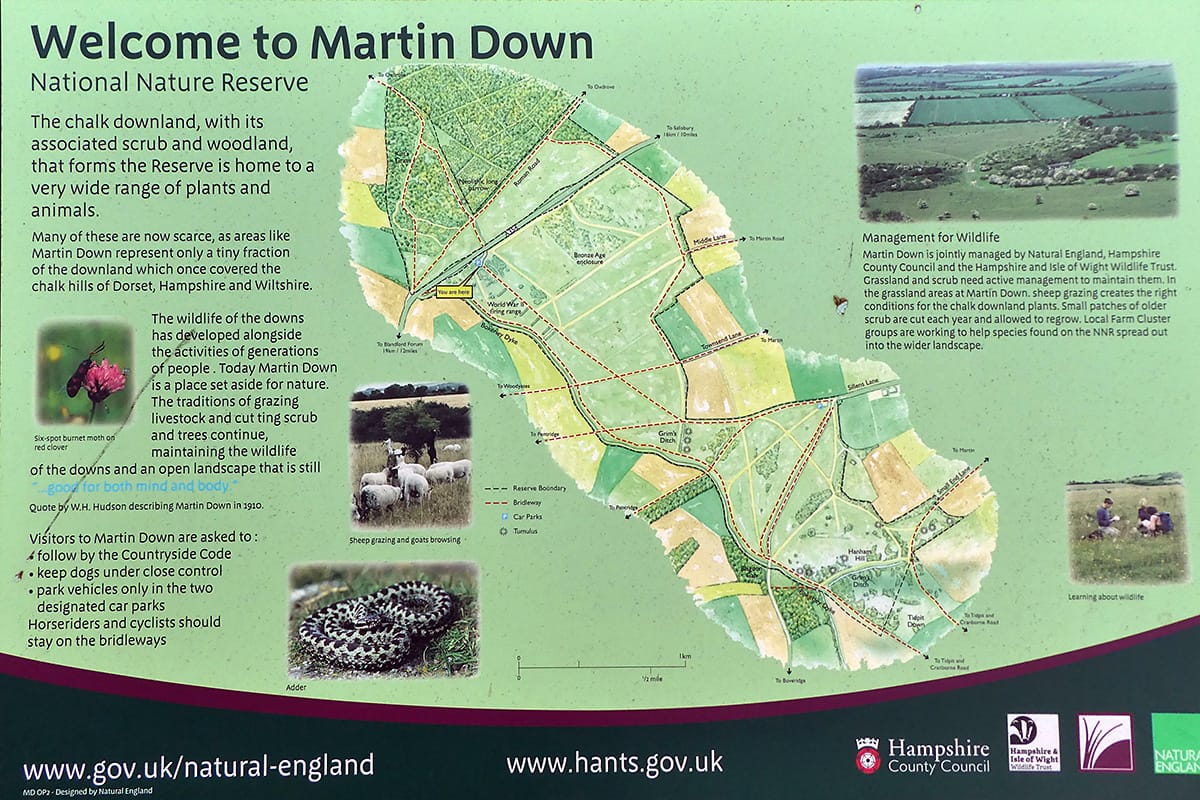
However, it sits within a nature reserve and the information board from Natural England gives a better sense of it.
More powerful than these tangible traces of what might have provided inspiration for Ford, however, was the experience of walking paths he might have trodden and that he had characters in Ladies Whose Bright Eyes retrace. The vistas are open; the terrain is gentle and often the only noise was from startled pheasants who reacted to our presence with the maximum amount of commotion and squawking. It made sense that Ford chose it as an area in which to walk away his nervous problems,11 and also as a setting in which Sorrell could easily feel that he had “no idea where he was”.12
Click here for Part 3 of this series of articles…
All photographs by Andrew Gustar, reproduced with permission.
- Ford Madox Ford, Return to Yesterday, (Manchester: Carcanet Press Limited, 1999), p. 219 ↩︎
- Conor Mark Jameson, Finding W. H. Hudson: The Writer Who Came to Britain to Save the Birds, (London: Pelagic Publishing, 2023), p. 214 ↩︎
- Max Saunders, Ford Madox Ford: A Dual Life, Volume I: The World Before the War (Oxford: Oxford University Press, 2012), p. 169 ↩︎
- Violet Hunt, The Flurried Years, (London: Hurst and Blackett Limited, 19..), p. 101. This copy, undated, gives the same account as the American version, published in 1926. ↩︎
- Andrew Gustar, ‘Mr. Sorrell’s Castles’, Last Post, Spring & Autumn 2022 Vol.1 Nos. 8 & 9, p. 25 ↩︎
- https://martinparishcouncil.gov.uk/?page_id=302 – accessed 7th April, 2026. ↩︎
- Inscription on gravestone in Martin church graveyard on 9th September , 2025. ↩︎
- Jameson, p. 214 ↩︎
- Ford Madox Ford, Portraits from Life; memories and criticisms of Henry James and others (Chicago: H. Regnery and Co., 1937), p. 42 ↩︎
- Gustar, Mr. Sorrell’s Castles, p. 30-33 ↩︎
- See Max Saunders, A Dual Life 1 for discussion of this. ↩︎
- Ford Madox Ford, Ladies Whose Bright Eyes (London: Constable and Co., 1911), p22 ↩︎